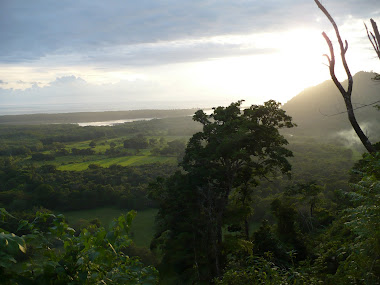
Vista del Gran Río Térraba y la desembocadura al mar

Vista del Gran Río Térraba  y la desembocadura al mar

domingo, 22 de agosto de 2010

La Romería

2 de Agosto de 2010

La Romería es un peregrinaje católico en Costa Rica, en lo cual miles de costarricenses acuden a la basílica de Nuestra Señora Los Ángeles, en Cartago, para rendir homenaje a la Negrita, la Santa Negra. Los romeros, o peregrinos, empiezan a peregrinar de todas partes del país para eventualmente llegar a Cartago el dos de agosto. Algunos romeros comienzan la travesía hasta una semana antes del dos de agosto, caminando 280 kilómetros, atravesando por terrenos y climas de todos tipos. Participé en este evento cultural con algunos amigos costarricenses.

No peregrinamos 280 kilómetros, sin embargo nuestro camino no era fácil. Partimos de Tarbaca, lo cual se ubica en las afueras de San José en las montañas, a las seis de la mañana. Porque mi sitio como un voluntario está en el sur del país y hace un tanate de calor, me costó acostumbrarme al clima fresco de Tarbaca en el inicio de la caminata. Me vestí en ropa larga para calentarme un poquito. Nos bajamos del cerro de Tarbaca, pasando por los suburbios de Aserrí y Desamparados, para eventualmente llegar a la carretera principal donde andaban en pelota el resto de los romeros, rumbo a Cartago. Como los indígenas, comimos pejibayes cuando teníamos hambre durante el viaje.


Aunque dije que los peregrinos caminan hacia Cartago, realmente la gente se va en todos tipos de formas. Hay romeros jinetes, romeros ciclistas, romeros motociclistas, romeros atléticos, romeros bebes que van en coche, etc. Además, aunque dije que es un evento católico, muchas de las personas que lo hacen, no son católicos. Por sí, algunos no tiene religión. Un peregrino me dijo a lo largo del camino que lo estaba haciendo por la tradición familiar, diversión, y ejercicio de la caminata.


Duramos 6 horas para llegar a la basílica, donde estuvieron todos los peregrinos - algunos descansando en el parque frente a la iglesia y otros haciendo fila para entrar. Hubo dos filas: una para entrar de pie y la otra para entrar de rodillas. Los que entraron de rodillas, se hincaron y se arrastraron en el suelo hasta que llegaron a la figura de la Negrita. La idea era que los peregrinos hicieran un sacrificio para la negrita o la ofrecieran algo. Entré de pie.


Y como uno hubiera predicho, siempre hay negocios que aprovechan de eventos como esto, promocionando sus productos en el nombre de los romeros y la Negrita. Es decir, mucha comercialización. Asimismo, había una gran cantidad de vendedores de comida, ropa, agua bendecida, eincluso lugares para recibir masajes para esos músculos y huesos que le dolían en el camino.


Aparte de ser algo espiritual, sentí, también, que la romería era un evento recreativo y comunitario, en lo que todos costarricenses - bebes hasta adultos - se reunieron a la vez para compartir. Estoy agradecido para poder hacer la romería con amigos y entender los muchos significativos de esta peregrinación en Costa Rica. Quiero hacerlo el próximo año, pero tal vez, empezando de Ciudad Cortés. ¡Eso sería una tregua! No sé si lo aguantaría.


Carlos

viernes, 20 de agosto de 2010

¿Qué se hizo?

So I know it’s been a while since I have posted, but I can assure you it has not been due to a lack of things to say. It’s actually due to a lack of time to sit down and write. These past couple weeks I have been busy with my work. During the first three months of being a volunteer in our community, one of our “jobs” is to write a Community Analysis Tool (CAT), which is basically a research paper on our community. It touches on everything: history, demographics, organizations and groups in the community, geography, etc. I put “job” in parenthesis because for me it wasn’t really a job. I enjoy doing field research. My CAT ended up being 42 pages all in Spanish. I am going to continue editing it throughout my service, as I will always learn something knew about where I live.

I have also been helping out with the local Empresa de Crédito Comunal, which is a type of micro-finance group in my community, teaching English two times a week, and helping out with music classes in a local school. We are almost ready to start giving individual music lessons. Of course, I have gone fishing a few times and taken a couple trips to the local beaches as well. Usually everyday here is an adventure.

In the near future, I’m going to post some blogs in Spanish for my Spanish-speaking audience. Also, be on the lookout for some new pictures. OK. That’s a small update for now.

Solo bueno,
Carlos

jueves, 29 de julio de 2010

Reacciones del Mundial desde Costa Rica

Reacciones del Mundial desde Costa Rica

When I found out that I would be living in a Latin American country during the World Cup, I was pretty excited. I imagined that the atmosphere in Costa Rica would be similar to that of March Madness in the United States. I have to say that I was somewhat disappointed, but I have to admit, if my country did not qualify for the World Cup I probably would not show too much interest either. I expected a celebratory atmosphere during the World Cup games, with large get-togethers of friends and family watching the games. In years past, when Costa Rica had qualified for the World Cup, this was the case. This World Cup was obviously a different story, as Costa Rica did not qualify.

All in all, however, it is clear that Costa Rica is a soccer playing country. Every morning during the World Cup games, community members were pegged to the television set watching every play attentively. This was especially evident when the big name teams like Brazil, Spain, or Portugal played. One pulperia owner even said that she had experienced less business due to the World Cup games.

I found it interesting the amount of Costa Ricans that were cheering for European teams instead of Latin American teams throughout the World Cup. The majority of community members I talked with rooted for Holland instead of Spain in the final game, even though Spain is a Spanish speaking country and has way more in common in terms of culture than Holland.

The last observation I made perhaps worth noting was the amount of attention given to Costa Rican soccer during the World Cup and the disillusionment of Costa Ricans because their team did not qualify. It seemed like every day in “La Nación” I would read a headline that asked what went wrong for Costa Rica for the team not to qualify, what the team will need to do to qualify for the next World Cup, and what Costa Rican players were doing during the World Cup games. It reminded me of the disappointment I experience when one of my sports teams in the U.S. does not make the NBA Playoffs or make it in to the Field of 64 for March Madness. Unfortunately, I guess disappointment is one thing sportsfans all around the world share.

Carlos

domingo, 25 de julio de 2010

Pescando en los esteros

Although fishing for a living in Ciudad Cortes is not as popular as it was in the past, fishing still is one of the favorite pass times for many in the community. El Gran Rio Terraba, the largest river in Costa Rica, passes through Cortes and eventually empties out into the Pacific Ocean. Cortes also is full of estuaries and mangroves which house an abundance of wildlife. I consider myself lucky to live in a fishing community, as I really enjoy doing it too.

I recently went on a fishing trip to the estuaries with one of my friends. It was an adventure. To get to the estuaries, we traveled first on bike through dirt gravel roads through the rice parcels, small farmers' fincas, and pastures of cattle. Eventually we reached a barbwire fence, which we crossed leaving our bikes behind. We traversed lagoons, marshy pastures with cattle, and small creaks along the way.

On this particular fishing trip, we fished with "camaron" (shrimp), which live in swampy ponds and lagoons. In the US, I was accustomed to fishing with "lombrices" (worms), which I think it is safe to say are much easier to find than camarones. We were able to find camarones after scavenging and scraping through various murky ponds. We used a mesh net, which we dragged on the bottom of the ponds to catch the camarones. It was a muddy muddy job, and I'm probably leaving out a lot of details. I actually enjoyed it and I learned a lot. It took about an hour to get sufficient an amount of bait. When my friend told me we would find camarones in some of the lagoons, I was quite surprised that life could exist there, but he was right.

We reached the estuaries at about 8:30 am, which was perfect timing as the tide was low. This means that all of the fish that came in on the high tide will be leaving the estuaries, which gives one a better chance to catch something. It's also good to be fishing when the tide is rising, as fish will be coming in to the estuary looking for food. In short, to fish successfully in the estuaries everything depends on the tides, which took me a while to understand.

We fish using "bolillos", which I think I will save the description of how they are made and how they are used for a future post. It is an art and is something I had to practice a lot, but I am getting pretty good with using them. It is way different than the poles we use in the US. I almost like "bolillos" more than poles. It has a more personal feel to it.

The trip was an overall success. We caught six "pargo", which came in on the high tide. These things are delicious fried. I even eat the eyes. Cleaning them is easy, however, they have some prickly scales that must be scraped off before cooking them.

It's hard to include every detail, but I assure you that it was a heck of a time. Scroll to the bottom of the page to see some pictures of the trip. I usually don't take my camera along when I go fishing here, but I took it with me this time.

jueves, 22 de julio de 2010

Costarriqueñismo #1 - "Ponerse al Chaine" and "Chapear"

I was hanging out with my friends who are owners of one of the local Panaderías this morning when one of them taught me a new phrase. I got my hair cut the other day and he told me that "se puso al chaine", meaning that I made a change to my hair, or I cut my hair. If you know anything about Spanish pronunciation you may see or hear the resemblance between the words "chaine" and "change." This is one of the many Anglicisms of the Spanish language here in Costa Rica - perhaps in much of Latin America. It would be interesting to know if the phrase exists in other parts of the Spanish speaking world. However, my friend assured me that it only exists in Costa Rica.

Another Costarriqueñismo would be "chapear", which is a frequently used verb to describe the workers in the "campo" cutting weeds and vegetation with the machete. I could be wrong on the origin of the word, but I would bet that it comes from the English word "chop". Once again, I am curious to know if it is used in other parts of Latin America.

The Anglicism of the Spanish language is a somewhat contentious topic in Costa Rica, especially among intellectuals. I find it interesting. I plan to post more Costarriqueñismos in the future, so be on the lookout for them. And before I forget, Costarriqueñismos do not always signify a word borrowed from English, as it can also be a word specifically used here in Costa Rica.

Carlos

miércoles, 21 de julio de 2010

In Costa Rica, "el chile" or "al chile?" means "la verdad" or "de verdad?". When translated to English, it more or less means "the truth" or "really?", depending on the context in which the phrase is used.

Having clarified the tentative name of my blog, I hope all readers of "El Chile de Costa Rica" enjoy its content. I cannot guarantee that I will write daily, but I promise to keep it updated as much as I can.

Toa,
Carlos