This is truly a cultural interchange, a fusion of cuisines between “tico” and “gringo”, latino and northamerican. I returned home today at 1:30 pm after working with youth in my neighborhood on environmental issues in the community. It’s Sunday so I cannot go to the Soda la Amistad. What will I eat quickly for lunch before I head to another meeting at 2:00 pm? I refuse to cook in the afternoon. It’s too hot. I open the fridge. A peanutbutter and jelly sandwich sounds great and quick. I have peanutbutter that a friend in my community gave me because he knew I liked it. I also have a jalea (jam) de guayaba that I made not too long ago. Wait, do I have pan (bread)? No hay pan. ¿Qué voy a hacer? OK, I’ll eat some peanuts with some yogurt. I eat them, but I’m still hungry. Wait, I have an idea. Brilliant! I have masa. I can make a tortilla and put peanutbutter and jelly on it! ¡Riquísimo!
I thought this was a funny anecdote and I wanted to share it with my readers (If I have any). In the US, it would have never occurred to me to make a tortilla. However, after living here for well over a year, I have to say that lots of cultural customs have rubbed off on me, especially the gastronomy. Making tortillas is something I have picked up and will share with friends and family back home.
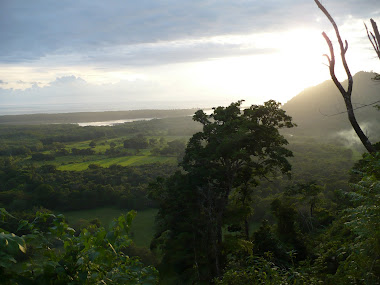
Vista del Gran Río Térraba y la desembocadura al mar
domingo, 30 de octubre de 2011

miércoles, 12 de octubre de 2011
Mamón frenesí - Mamón Chino


“Mamón frenesí” o “Mamón Manía” is what I call it. Starting in July, the mamón chino harvest begins in my community and lasts until mid-late September. I call it the “confite” or, candy of Costa Rica, as streets and yards are filled with the peelings of the fruit, similar to the large quantity of candy wrappers that can be found on the ground. Internationally, the fruit is known as Rambutan. However, in Costa Rica it is called “mamón chino.” The fruit itself is round, about the size of a ping-pong ball, and its flesh has a yellowish white color. To eat the fruit, one must break open the skin or cascara, which can either be done with one’s mouth or hands. There are two varieties, red and yellow, some of which are sweet and some of which are acid, depending on the quality of the mamón. Both varieties are surrounded by an outside skin which is covered with a leathery hair, which may appear prickly but is in reality harmless. The fruit is not indigenous to Costa Rica, and is said by many in my community to have been brought by the United Fruit Company. The actual origin of Rambutan is East Asia. The fruit is tropical and has many interesting qualities.
In my backyard, I have a mamón chino fruit tree. This year’s harvest was a good one. The fruit is harvested using what is called a “varilla,” which usually has long blades to cut the clusters (piñas) of mamones. Although I enjoy eating mamón chino, I mostly let my neighbors and kids in the neighborhood harvest the tree. You know it’s a frenesí when you come home in the afternoon from an activity and an 11 year old boy from my neighborhood is 25 feet up in the tree trying to lower himself some piñas de mamón.
Why am I not a “mamonero” (this is the term I use for a mamón addict)? First, I prefer many other tropical fruits that abound in my community, such as papaya or aguacate (mmmm guanabana). Second, many of my friends have mamón chino trees as well, so I have people constantly trying to give me mamón chinos to take home. I like to eat mamón chino in “conserva” instead of eating it in its raw state, as cooking it allows me to eat the seed as well. When cooked, the seed has a taste similar to almond or cashew.
The harvest in my community is so large that most people with a big harvests of mamones don’t know where to send them to be sold. In other words, there isn’t a large enough local market. I have always thought that with some further investigation, a market could be found somewhere in Costa Rica. Interestingly, one day I passed by the local MAG office, which is the agricultural department of Costa Rica, and two of the workers were taking tests of mamón chinos from local fincas that produce the fruit in large quantities. They were checking for features such as acidity, thickness of the fruit, size, weight, sweetness, etc. These tests were being taken to improve the future quality of the fruit.
It’s a true frenesí. There are tons of tropical, delicious fruits to be eaten in my community that are, in large part, not ever harvested and are left for the birds. Mamón chino, however, is one fruit that people in my community truly value and will spend the time to pull them down, or even climbing up in the tree to cut down the most difficult clusters of mamones.
La droga perfecta
They say that caffeine is a drug. Although by no means am I addicted, I have to say that there is nothing better than sitting down and sharing an afternoon cup of coffee with some great friends in my community. The “cafecito” is one of my favorite and most appreciated aspects of the Costa Rican culture. Even though coffee production is definitely not one of the agricultural activities in my community, as I live in a tropical climate, the afternoon café is still quite ingrained as one of the daily activities.
I love having cafecitos with friends, chatting about a range of subjects - from politics to differences and similarities between US and Tico cultures – and munching on a piece of cheese, bread, or tortilla. It’s even better during Christmas when families and friends are making tamales. ¡Qué rico! Under the influence of café, I have had some of my most memorable conversations with my Tico friends and counterparts. We even come up with new and ambitious project ideas. I usually finish my cafecito feeling like I am on top of the world and that I can help organize any event or work with any mini-empresario. The cafecito is also a time to reflect and can be relaxing.
There is an essence to sharing café and conversing one-on-one with family members or friends. The cafecito could help me sum up what my experience in the Peace Corps is about, which is collaborating and working with people. When my time in the Peace Corps finishes, I’m going to miss the cafecito and look back on it nostalgically, not necessarily for the café or the tortillas, but for the friendships and relationships that having the cafecito helped form.
I love having cafecitos with friends, chatting about a range of subjects - from politics to differences and similarities between US and Tico cultures – and munching on a piece of cheese, bread, or tortilla. It’s even better during Christmas when families and friends are making tamales. ¡Qué rico! Under the influence of café, I have had some of my most memorable conversations with my Tico friends and counterparts. We even come up with new and ambitious project ideas. I usually finish my cafecito feeling like I am on top of the world and that I can help organize any event or work with any mini-empresario. The cafecito is also a time to reflect and can be relaxing.
There is an essence to sharing café and conversing one-on-one with family members or friends. The cafecito could help me sum up what my experience in the Peace Corps is about, which is collaborating and working with people. When my time in the Peace Corps finishes, I’m going to miss the cafecito and look back on it nostalgically, not necessarily for the café or the tortillas, but for the friendships and relationships that having the cafecito helped form.
jueves, 6 de octubre de 2011
Sounds from the morning 2
It’s 10:30 AM, and as usual in September, at about this hour the morning coolness is wearing off and the afternoon’s sun begins to heat up the tin roofs, making the sound of rain drops as if it were raining. Quite the contrary. It’s just the beginning of an especially dry winter day. We’ll see if this drier weather continues on to October and November, the most heavy hit months for rain.
A man passes the house, shirtless, tugging on his shoulders and head a jumble of pots, pans, and other cast-iron cooking utensils. Who knows where he’s from. I have never seen him before in the community. He’s got to be incredibly strong. He passess by house to house, hoping that a “señora” leaves her morning chores (oficios) to buy something: “SARTENES, OLLAS, COMALES!”, he shouts. These are the perfect tools for this Christmas’ tamales, chicharrones, olla de carnes, and other frituras.
I have no plans to buy anything from him. But I have to admire his determination to even try to sell anything in this heat, much less do so carrying around iron pots and pans. He probably doesn’t even profit much from what he sells, but the little he gains he will take home to his family. It’s humbling. He’s one of the many venders that pass my road from time to time selling anything from newspapers, bread, oranges, to rugs. I hardly ever buy anything from them, but I appreciate listening to their chants from inside the house as they pass by selling.
A man passes the house, shirtless, tugging on his shoulders and head a jumble of pots, pans, and other cast-iron cooking utensils. Who knows where he’s from. I have never seen him before in the community. He’s got to be incredibly strong. He passess by house to house, hoping that a “señora” leaves her morning chores (oficios) to buy something: “SARTENES, OLLAS, COMALES!”, he shouts. These are the perfect tools for this Christmas’ tamales, chicharrones, olla de carnes, and other frituras.
I have no plans to buy anything from him. But I have to admire his determination to even try to sell anything in this heat, much less do so carrying around iron pots and pans. He probably doesn’t even profit much from what he sells, but the little he gains he will take home to his family. It’s humbling. He’s one of the many venders that pass my road from time to time selling anything from newspapers, bread, oranges, to rugs. I hardly ever buy anything from them, but I appreciate listening to their chants from inside the house as they pass by selling.
jueves, 15 de septiembre de 2011
Fruta Milagrosa
As you can imagine there is an incredible variety of tropical fruits in Latin America that many in the U.S. will never have the luxury or luck to try. Quite often, I am introduced to a new, interesting fruit. Not too long ago, I was in the local MAG office, when my friend Carlos, one of the MAG workers wanted to show me a fruit called Fruta Milagrosa (Miracle Fruit, also called Fruta Mágica (Magical Fruit)). Enthusiastically he explained to me that after eating one of these small fruits, which are about the size and shape of a blueberry, all foods that I eat will have a sweetish taste to them. The fruit is also similar in appearance to coffee. The fruit grows on a small bush. I’m not sure if this particular bush will grow much taller but it is currently about 3 feet tall. The fruit tastes similar to a sourer blackberry and has a seed inside.
As Carlos has a propensity to exaggerate, I skeptically believed him and ate the fruit. About 15 minutes later, I went to eat lunch in La Amistad. I had already forgotten that I had eaten the so called “fruta milagrosa” earlier, as I had put little belief into what Carlos had told me, as it sounded like something from a Lord of the Rings movie.
I put a good amount of “chilero” on my food because I like the spicy taste. I don’t have a weak tongue. I took my first bite of rice and beans and I was surprised by the fact that today, lunch had a sweet taste to it. I definitely didn’t notice any of the chile that I had poured on. I could literally eat the seeds of a hot chile pepper and not have any burning sensation. After a few more bites, I then remembered that I had eaten the Fruta Milagrosa, which must be the reason for the pleasant fruity taste to my food. Carlos didn’t exaggerate after all. This fruit, among many others that I have had the pleasure to eat here in Costa Rica, is definitely unique and unlike any other fruit that I have eaten in the U.S.
As Carlos has a propensity to exaggerate, I skeptically believed him and ate the fruit. About 15 minutes later, I went to eat lunch in La Amistad. I had already forgotten that I had eaten the so called “fruta milagrosa” earlier, as I had put little belief into what Carlos had told me, as it sounded like something from a Lord of the Rings movie.
I put a good amount of “chilero” on my food because I like the spicy taste. I don’t have a weak tongue. I took my first bite of rice and beans and I was surprised by the fact that today, lunch had a sweet taste to it. I definitely didn’t notice any of the chile that I had poured on. I could literally eat the seeds of a hot chile pepper and not have any burning sensation. After a few more bites, I then remembered that I had eaten the Fruta Milagrosa, which must be the reason for the pleasant fruity taste to my food. Carlos didn’t exaggerate after all. This fruit, among many others that I have had the pleasure to eat here in Costa Rica, is definitely unique and unlike any other fruit that I have eaten in the U.S.
domingo, 11 de septiembre de 2011
Eating Habits
It may be of interest to my family and friends to know what my eating habits are like in Costa Rica. Although I live on my own, I still keep much of what I eat pretty Tico. After all, there is nothing better than a plate of gallo pinto for breakfast or a typical casado for lunch. In the US, I almost always ate a bowl of oatmeal for breakfast. In Costa Rica, I still eat my bowl of oatmeal. However, on the side I like to have a bowl of chopped papaya, pineapple, and coco, and a side plate of plátano maduro. I know it’s a lot of fruit and may even be too much, but I certainly am not gaining weight and when there is so much abundance, I figure why not take advantage of the extra vitamins.
For lunch, I eat at the local “soda” La Amistad. Doña Norma, the restaurant’s cook and owner treats me like a son and always serves me a riquísimo typical Costa Rican casado or soup. On Mondays she prepares my favorite, olla de carne, which is similar to a beef stew in the US. Olla de carne is loaded with ayote (a type of squash), chayote, plátano, yuca, camote (sweet potato), papa (potato), cilantro, cebolla (onion), etc. Thursday is another soup day, though it varies which type of soup. She sometimes prepares a sopa de pescado o pollo, but usually she makes a sopa de mondongo, which uses the cow�e99s stomach. The other days of the week, I eat the classic “casado”, which consists of a plate of rice, beans, a picadillo and/or salad with pollo en salsa, carne en salsa, bistek, or chuleta. I especially enjoy eating at La Amistad because I always have great conversations with the restaurant’s owner and its clients, as many work in the OIJ (the Costa Rican government’s FBI), the local courthouse, the hospital, or are older community members that have unbelievable stories about what Ciudad Cortés was like in the United Fruit Company years.
Around 4:00 PM, I like to have a cafecito with my friends from the Panadería Murillo. We like to drink our coffee strong, which we jokingly call “café con el “American Touch.” El cafecito gives me that extra boost to participate in my evening activities. Its always accompanied by a good conversation con mis amigos.
For dinner, I typically prepare my famous “sancocho” with an egg or a slice of cheese. The “sancocho”, which I have proudly nicknamed it, consists of a huge bowl of vegetables that I have either grown in my garden such as okra, yucca, green beans, and mustard, or that I have bought from one of the local farmers such as ayotes or elotes (corn). I also throw in all the spices that I have in my garden such as chile peppers, basil, oregano, ginger, tumeric, cilantro, and lemon grass. I have to say, it’s quite simple (or complex) – a huge bowl of boiled vegetables with a piece of cheese (which is also bought locally) – but I have never gotten tired of it. I’m so accustomed to always having fresh produce that when I go back to the US, not having access to the abundance of fruits and vegetables will be something that is difficult to get accustomed to.
For lunch, I eat at the local “soda” La Amistad. Doña Norma, the restaurant’s cook and owner treats me like a son and always serves me a riquísimo typical Costa Rican casado or soup. On Mondays she prepares my favorite, olla de carne, which is similar to a beef stew in the US. Olla de carne is loaded with ayote (a type of squash), chayote, plátano, yuca, camote (sweet potato), papa (potato), cilantro, cebolla (onion), etc. Thursday is another soup day, though it varies which type of soup. She sometimes prepares a sopa de pescado o pollo, but usually she makes a sopa de mondongo, which uses the cow�e99s stomach. The other days of the week, I eat the classic “casado”, which consists of a plate of rice, beans, a picadillo and/or salad with pollo en salsa, carne en salsa, bistek, or chuleta. I especially enjoy eating at La Amistad because I always have great conversations with the restaurant’s owner and its clients, as many work in the OIJ (the Costa Rican government’s FBI), the local courthouse, the hospital, or are older community members that have unbelievable stories about what Ciudad Cortés was like in the United Fruit Company years.
Around 4:00 PM, I like to have a cafecito with my friends from the Panadería Murillo. We like to drink our coffee strong, which we jokingly call “café con el “American Touch.” El cafecito gives me that extra boost to participate in my evening activities. Its always accompanied by a good conversation con mis amigos.
For dinner, I typically prepare my famous “sancocho” with an egg or a slice of cheese. The “sancocho”, which I have proudly nicknamed it, consists of a huge bowl of vegetables that I have either grown in my garden such as okra, yucca, green beans, and mustard, or that I have bought from one of the local farmers such as ayotes or elotes (corn). I also throw in all the spices that I have in my garden such as chile peppers, basil, oregano, ginger, tumeric, cilantro, and lemon grass. I have to say, it’s quite simple (or complex) – a huge bowl of boiled vegetables with a piece of cheese (which is also bought locally) – but I have never gotten tired of it. I’m so accustomed to always having fresh produce that when I go back to the US, not having access to the abundance of fruits and vegetables will be something that is difficult to get accustomed to.
sábado, 27 de agosto de 2011
Sounds from the morning
The sun rises and sets early here in Costa Rica. That means if one wants to take advantage of daylight, and the coolness of the morning before it gets hot and humid, one needs to wake up quite early, at least for US standards. Activity - and not always human activity - usually starts around 5:30 AM. Like it or not, I am almost always waken up around this time by either the seemingly thousands of roosters that surround my house or the chirping of the “cocalecas.” The scientific name for this bird species is Aramides cajanea. Cocaleca is the word Costa Rican’s use, perhaps because they make a sound that is somewhat similar to the name.
By about 6:00 AM, the sounds of bicycles passing my house begin to be heard. There are several bread-sellers that ride through the neighborhoods with large carts filled with baguettes attached to the front of a bicycle and a horn attached to the handlebar to signal the arrival of the day’s freshly baked bread. “LLEGOOOO LLEGOOOO…… (HORN SOUNDS).” By this point it’s about 6:30 AM and the borrowed U.S. yellow school bus, which is used to transport locals from Cortés to Ojo de Agua instead of students, rumbles by, shaking the foundation of my house.
By 7:00 AM, the streets have quite a bit of activity as high school and elementary students are on their way to school, gently poking along on their bikes while talking in groups of friends. Also, many adults are reporting to work at this time. This routine is quite different to that in the US, where many people on a work day aren’t getting to work until 8:00 or 8:30 AM.
With all these sounds and movements, it definitely puts pressure on me to start my days bright and early with lots of activity. This can lead to exhaustion by the end of the day, as many of my activities don’t actually start until the evening. This means I start my day at 6:00 AM, but it often doesn’t finish until 9:00 PM. It’s safe to say, by the end of the days I am sometimes dizzy due to fatigue. I am still working on finding an equilibrium between resting sufficiently and taking advantage of the sunlight before it gets dark at 5:30 PM.
By about 6:00 AM, the sounds of bicycles passing my house begin to be heard. There are several bread-sellers that ride through the neighborhoods with large carts filled with baguettes attached to the front of a bicycle and a horn attached to the handlebar to signal the arrival of the day’s freshly baked bread. “LLEGOOOO LLEGOOOO…… (HORN SOUNDS).” By this point it’s about 6:30 AM and the borrowed U.S. yellow school bus, which is used to transport locals from Cortés to Ojo de Agua instead of students, rumbles by, shaking the foundation of my house.
By 7:00 AM, the streets have quite a bit of activity as high school and elementary students are on their way to school, gently poking along on their bikes while talking in groups of friends. Also, many adults are reporting to work at this time. This routine is quite different to that in the US, where many people on a work day aren’t getting to work until 8:00 or 8:30 AM.
With all these sounds and movements, it definitely puts pressure on me to start my days bright and early with lots of activity. This can lead to exhaustion by the end of the day, as many of my activities don’t actually start until the evening. This means I start my day at 6:00 AM, but it often doesn’t finish until 9:00 PM. It’s safe to say, by the end of the days I am sometimes dizzy due to fatigue. I am still working on finding an equilibrium between resting sufficiently and taking advantage of the sunlight before it gets dark at 5:30 PM.
sábado, 20 de agosto de 2011
“Un día de estos”
This is a common saying among Ticos. It’s equivalent to saying “one of these days….” in English. It has the same promise (or sometimes vagueness of when or if it will happen) of an event passing in the future. It’s used in the context of when someone is promising to plan a trip, project, or cafecito with someone. For example, it’s to say, “One of these days, we’re going to go on that fishing trip that we have been talking about for the past year.” I hear it so often, that I usually think to myself “And if one of these days never comes?” Because the truth is, that time, ever since I joined the Peace Corps has never been the same. Why is time passing by so quickly? Is it the same for those that live in other parts of the world? Back home? Or does time only fly in Costa Rica? Are the days, weeks, months, and years getting shorter? I was talking with a friend in my community about this, and he told me that somewhere in the Bible it states that when the end of the world is near, time will become shorter. It almost seems true. I often reflect, stunned, by the fact that I’m already 25 years old, or that there are only about 4 months left in this year’s calendar. Time’s shortness for me can almost be unfair. Everyday, I try to make the most out of the little time I have, because time for me is flying.
miércoles, 17 de agosto de 2011
Ode to Gallo Pinto
Gallo pinto is a classic Costa Rican dish, usually eaten for breakfast, which consists of rice and beans mixed together with chopped onion, red pepper, and cilantro. Of course, one cannot forget to throw in a little Salsa Lizano, a Costa Rican brand sauce, which if not added, would probably not be gallo pinto. Although it varies from person to person, garlic is also sometimes added. I have to admit, I am a fanatic of the pinto, especially for breakfast. For me, there is nothing better than a plate of gallo pinto, a slice of cheese or an egg, tortilla, and a large cup of warm café in the morning. If the pinto is well-made, I could honestly eat it for lunch and dinner as well.
Ironically, even when I am living by myself, I still like to fix myself gallo pinto. However, my pinto is made with an “estilo gringo.” I use the above ingredients, however I also like to use lots of fresh spices from my garden, such as fresh ginger, turmeric, lemon grass, basil, cilantro, and oregano. I know, lots of spices, but since I am growing them, why not use them? It only adds to the taste. Also, for the pinto to have a little kick, I also throw in a small chile pepper and a piece of garlic. That’s my version of the traditional gallo pinto. It’s one of the many customs that I will definitely take back with me to the U.S. after I finish the Peace Corps.
Ironically, even when I am living by myself, I still like to fix myself gallo pinto. However, my pinto is made with an “estilo gringo.” I use the above ingredients, however I also like to use lots of fresh spices from my garden, such as fresh ginger, turmeric, lemon grass, basil, cilantro, and oregano. I know, lots of spices, but since I am growing them, why not use them? It only adds to the taste. Also, for the pinto to have a little kick, I also throw in a small chile pepper and a piece of garlic. That’s my version of the traditional gallo pinto. It’s one of the many customs that I will definitely take back with me to the U.S. after I finish the Peace Corps.
miércoles, 15 de junio de 2011
La cangrejeada - Not this year....

This past winter season my community - and my home - were flooded with over 4 feet of water for several days. I was forced to evacuate to higher grounds to the neighboring town, Palmar Norte. Although I had tried to stack up all of my clothes and other accessories on top of my table and dresser, unfortunately when the water entered the house there were strong currents that knocked the table over, ruining some of my things and muddying up others (like clothes).
Although I could spend much time upset about what I lost, I realize that my problems were very little in comparison with those who had lost things more valuable, who couldn’t stack up their refrigerator or washing machine before the water came rushing in at 4:30 AM. I also think about all of the small businesses in the center of Cortés that lost much of their inventory and had to start again from scratch.
Interestingly, not only were peoples’ lives affected by the floods of this winter, so too was the environment and its habitat. The largest river in Costa Rica, El Terraba, which starts in the mountains of Talamanca, passes through my community. Furthermore, many winding estuaries and mangrove swamps branch off from the river. After this year’s winter storm, several local community members have said that the river, estuaries, and mangroves have changed dramatically.
One particular community member, and close friend, that has been fishing in the Terraba for over 40 years has been helpful in explaining to me how much the area has changed after this past winter. Land masses that were once on one side of the river are now located on the other side due to the force of the water. Canals and estuaries that once were fished and traveled by locals by boat, now no longer exist, and are filled with mud and sand carried by the river.
My friend has been directly affected by these changes. His finca, which is backed by mangrove swamp and is only reachable by boat, was also altered. Before, he was able to travel to his finca to work at any point of the day – low tide or high tide. However, after the tropical storm, he is only able to arrive by boat during high tide, when the estuaries and river have more water. When the tide is low, the estuary is a muddy lagoon and does not have sufficient water to enter. Furthermore, the mangrove swamp that backs his farm was filled with sand, drying out and killing most, if not all plant life.
Rancho Quemado, which has always been a pasture which rolls along the river - and a popular point for community members to fish - was left unrecognizable. I had gone several times before the winter storm, and the pasture was quite swampy, with tall grass and a mud-rich soil. Now, the pasture is almost a sandy beach. Instead of cattle, the owner of this farm now plants rice, as grass doesn’t grow well in this terrain.
Most interestingly, Ranch Quemado has historically been the place where community members “cangrejear” - a special time of year toward the end of May when the cangrejos (crabs) come out of their caves in such large quantities that people can fill sacks with crabs. This has been a Ciudad Cortés tradition throughout the entire history of the town. This year, however, the “cangrejeada” did not happen.
As this type of cangrejos’ habitat is mud, Rancho Quemado no longer houses the thousands of crabs that it once held. It is now sand-filled. I was able to make the trip with my friend this May in search for cangrejos. Several others also had the same idea. We passed many people in bicycle en route to Ranch Quemado. All were quite disappointed and confused as to why there were no cangrejos this year. The answer lies in the fact that the past winter storm affected and changed everything; from peoples’ lives, to the community, to the environment.
sábado, 21 de mayo de 2011
La cosecha de aguacate

Ahhhhh aguacate..... There is nothing as glorious as the harvest of aguacate (avocado) in my community. Around this time of year, from May to June, the town is flooded in aguacates. I'm not talking about the small hass avocados that I was accustomed to eating in the U.S. I'm talking about criollo aguacates the size of pillows! For the past 2-3 weeks, I have eaten a whole avocado for lunch and dinner, respectively. I really appreciate the abundance of fruits and vegetables here in Costa Rica. There are avocado trees that have been planted for over 40 years and that are so tall, sometimes the only way to harvest the fruit is to wait until it falls to the ground and hope that it doesn't splatter. When the fruits are high up in the tree, we use a long piece of bambu with a type of bag attached to the end to grab the aguacate. Another method is to simply shake the branches with the long bambu and have another person with you to try and catch the aguacate when it falls!
There are different types of aguacates, varying in size, shape, color, and taste. I have eaten some avocados that tasted like butter and others that have been sweeter. Yesterday, I ate one that is almost white on the inside. I have eaten some aguacates that were shaped like a butternut squash and almost equal in size! Writing this blog makes me hungry. The guacamole I have made has been tremendously delicious, using almost all fresh ingredients. I'm definitely getting spoiled to eating lots of aguacate and will miss it when the cosecha (harvest) is over!
Carlos
jueves, 10 de febrero de 2011
An update....
Time flies in Costa Rica. Since November my life has been a rollercoaster. In late October-early November the winter storms devastated my house and community. For 3 days the center of Ciudad Cortes (which is where I live) was covered in 1-3 meters of water. The aftermath left 3 inches of mud throughout my house and small fish flopping around in my room. I had to evacuate my community during this period. It’s safe to say that the clean up in and around my house wasn’t too easy!
For the Thanskgiving Holiday, I had dinner with a family from the U.S. Embassy here in Costa Rica. I had a great time and met a lot of interesting people. Also, students from my English class and I organized our own Thanksgiving party in my community. We killed and roasted three chickens (which actually tasted more like turkey), had corn on the cob, potato salad, tortillas, slaw, pumpkin/winter squash bread (actually pan de ayote, which I made for the desert). We had a great time. After eating, we sang karaoke and danced to los ritmos tropicales.
From December to the middle of February many Costa Ricans take off for the summer vacations, especially those that work in the school system or that work for the government. During this time, people in my community do a little bit of everything. Since one of the popular pastimes in my town is fishing and going to the local beaches, I especially enjoyed it as this gave me an opportunity to take some fun fishing trips and have some great cultural experiences, learning more and more about my community. A few weekends ago I went camping on the beach with several Tico families.
From December 23-28, I had two special visitors from the U.S. - my mom and my aunt. It was a whirlwind tour of my community and the surrounding area. I think by the end of the trip they were both exhausted, but overall had a great time and carried back some unforgettable memories. We visited many friends and family from my town. It was a great cultural experience for them because they got to see what a Tico Christmas was like and they got to have lots of cafecitos with tamales. Two of my good friends, Javier and Jonathan, gave my mom and aunt a tour of the mangrove swamps, estuaries, and el Río Térraba in boat. We visited the aunt and uncle of Jonathan, who basically live on an island where the river empties out into the Pacific Ocean. If you want to be specific, we went to one of the many mouths of el Térraba, Boca Chica (Here is a link to see some fotos from the trip: http://www.facebook.com/#!/album.php?aid=38709&id=100000750415407). I also wanted them to see the archeological site in Finca 6, which displays many of the mysterious indigenous stone spheres that are only found in the zona sur of Costa Rica. I did lots of translating, but we also spoke lots of Spanish, which was fun. Of course, we also went to the many local beaches that are around my area. The final night, we had a special dinner party with several of the members from my English class.
In early January, two fellow Peace Corps Volunteers and I did the Corcovado National Park hike. It was an amazing trip and quite tiring. The first day is a hike across the Osa Peninsula. We say an abundance of wild animals - most of which are in danger of extinction – and different types of vegetation. Much of the hike is completed walking through rain forest. However, there is also a pretty large portion of the hike which is done walking along the beach. I preferred walking through the rain forest, as we were able to see much more animals and different types of fauna. I posted lots of fotos from the trip on my Facebook account. Here is the link: http://www.facebook.com/album.php?fbid=541111042418&id=44701811&aid=2049040&ref=pd.
Throughout the months of December and January I had been working with a youth group from the Cruz Roja (Red Cross) on a series of environmental problems found in the community. During the sessions, the participants investigated a specific issue, such as contaminated water or soil sources, or what have been the effects of climate change on the community in recent years. At the end of the project, two of the participants put together a Powerpoint presentation of their findings, which was later presented in an environmental workshop/forum in Bahía Ballena. Unfortunately, the two participants were unable to attend, but luckily another community member that is quite interested in environmental issues helped present the final project.
I’m almost a year into my service, which meant it was time to go to San Jose for my medical and dental check-up. The doctor commented on how well my health had been this year, but ironically, only a week later I burned my hand with boiling water and had to go to the hospital for a couple of days. I would have preferred to watch the Super Bowl, but I guess it wasn’t meant to be. That’s my most recent experience. Luckily, I’m doing much better and my hand is recovering, but I cannot explain the amount of pain my hand was in when it initially happened.
What else is new? Summer vacation is almost over and school is starting back up here in Costa Rica. I’m looking forward to starting up some new projects in my community. We’ll see how things go. If there is one thing I have definitely learned during my time here, it’s that one can never be certain of what will happen in some of the seemingly most certain circumstances. I’m sorry for not keeping things updated more frequently. I’ll try my best, but like I said, time flies here in Costa Rica as a Peace Corps Volunteer!
For the Thanskgiving Holiday, I had dinner with a family from the U.S. Embassy here in Costa Rica. I had a great time and met a lot of interesting people. Also, students from my English class and I organized our own Thanksgiving party in my community. We killed and roasted three chickens (which actually tasted more like turkey), had corn on the cob, potato salad, tortillas, slaw, pumpkin/winter squash bread (actually pan de ayote, which I made for the desert). We had a great time. After eating, we sang karaoke and danced to los ritmos tropicales.
From December to the middle of February many Costa Ricans take off for the summer vacations, especially those that work in the school system or that work for the government. During this time, people in my community do a little bit of everything. Since one of the popular pastimes in my town is fishing and going to the local beaches, I especially enjoyed it as this gave me an opportunity to take some fun fishing trips and have some great cultural experiences, learning more and more about my community. A few weekends ago I went camping on the beach with several Tico families.
From December 23-28, I had two special visitors from the U.S. - my mom and my aunt. It was a whirlwind tour of my community and the surrounding area. I think by the end of the trip they were both exhausted, but overall had a great time and carried back some unforgettable memories. We visited many friends and family from my town. It was a great cultural experience for them because they got to see what a Tico Christmas was like and they got to have lots of cafecitos with tamales. Two of my good friends, Javier and Jonathan, gave my mom and aunt a tour of the mangrove swamps, estuaries, and el Río Térraba in boat. We visited the aunt and uncle of Jonathan, who basically live on an island where the river empties out into the Pacific Ocean. If you want to be specific, we went to one of the many mouths of el Térraba, Boca Chica (Here is a link to see some fotos from the trip: http://www.facebook.com/#!/album.php?aid=38709&id=100000750415407). I also wanted them to see the archeological site in Finca 6, which displays many of the mysterious indigenous stone spheres that are only found in the zona sur of Costa Rica. I did lots of translating, but we also spoke lots of Spanish, which was fun. Of course, we also went to the many local beaches that are around my area. The final night, we had a special dinner party with several of the members from my English class.
In early January, two fellow Peace Corps Volunteers and I did the Corcovado National Park hike. It was an amazing trip and quite tiring. The first day is a hike across the Osa Peninsula. We say an abundance of wild animals - most of which are in danger of extinction – and different types of vegetation. Much of the hike is completed walking through rain forest. However, there is also a pretty large portion of the hike which is done walking along the beach. I preferred walking through the rain forest, as we were able to see much more animals and different types of fauna. I posted lots of fotos from the trip on my Facebook account. Here is the link: http://www.facebook.com/album.php?fbid=541111042418&id=44701811&aid=2049040&ref=pd.
Throughout the months of December and January I had been working with a youth group from the Cruz Roja (Red Cross) on a series of environmental problems found in the community. During the sessions, the participants investigated a specific issue, such as contaminated water or soil sources, or what have been the effects of climate change on the community in recent years. At the end of the project, two of the participants put together a Powerpoint presentation of their findings, which was later presented in an environmental workshop/forum in Bahía Ballena. Unfortunately, the two participants were unable to attend, but luckily another community member that is quite interested in environmental issues helped present the final project.
I’m almost a year into my service, which meant it was time to go to San Jose for my medical and dental check-up. The doctor commented on how well my health had been this year, but ironically, only a week later I burned my hand with boiling water and had to go to the hospital for a couple of days. I would have preferred to watch the Super Bowl, but I guess it wasn’t meant to be. That’s my most recent experience. Luckily, I’m doing much better and my hand is recovering, but I cannot explain the amount of pain my hand was in when it initially happened.
What else is new? Summer vacation is almost over and school is starting back up here in Costa Rica. I’m looking forward to starting up some new projects in my community. We’ll see how things go. If there is one thing I have definitely learned during my time here, it’s that one can never be certain of what will happen in some of the seemingly most certain circumstances. I’m sorry for not keeping things updated more frequently. I’ll try my best, but like I said, time flies here in Costa Rica as a Peace Corps Volunteer!
lunes, 1 de noviembre de 2010
Clases de baile y mejengas de baloncesto
It has been a while since I made a post about what I have been up to in Costa Rica as a Peace Corps Volunteer. I don’t always write consistently because I am either too busy or having too good of a time. I am still giving English and computer classes, along with my “Economía para el Éxito” class that I give in the local high school every Tuesday afternoon. I do this along with other side projects that I have going and random activities that I do in my community.
Speaking of side projects and activities, lately I have been playing basketball with a group of Ticos in one of the neighboring towns. It’s a pretty good sized group considering Costa Rica is an overwhelmingly soccer country. We usually always have at least 6 players, which is enough to break a good sweat playing 3-on-3. A couple times we had as many as 12 players.
I have to say that while my Spanish is pretty good, it took me a couple of games to get my Spanish basketball vocabulary up to par, as I don’t need to use it very often. I remember the first time the man I was guarding went to set a screen, my first instinct was to shout out “Screen left!” I have super fun learning all of the basketball vocabulary. We say that we have formed a local team and that we are going to travel to Pérez Zeledón, one of the bigger cities in Costa Rica, to compete in “la primera division.” We will see what happens with that. For now, I am happy to get to play basketball about once a week. I consider myself pretty lucky, as I never imagined myself playing basketball during my Peace Corps experience. We are going to try to start a team in the high school. That will be the beginning of my coaching career.
The other activity that I have going on is that I am learning how to dance to some of the “ritmos tropicales”, such as cumbia, merengue, bachata, bolero, and salsa. I go to a dance class once a week. I have never been able to dance well, but after a few classes and going to a few “bailes” I am getting pretty good. La cumbia, or swing, is my favorite ritmo. It’s more playful. I never realized how fun it is to dance. I consider learning how to dance to “los ritmos tropicales” as important as learning the Spanish language. It’s part of the cultural experience. I have been told that a man that cannot dance in a Latin American country isn’t really a man. Furthermore, going to a “baile” and not knowing how to dance to any of the “ritmos” is like going to a basketball game and being injured. You will always be on the sideline and never in the game.
That’s all I have for now. I should have another post up in a few days for my Spanish readers.
Pura Vida,
Carlos
Speaking of side projects and activities, lately I have been playing basketball with a group of Ticos in one of the neighboring towns. It’s a pretty good sized group considering Costa Rica is an overwhelmingly soccer country. We usually always have at least 6 players, which is enough to break a good sweat playing 3-on-3. A couple times we had as many as 12 players.
I have to say that while my Spanish is pretty good, it took me a couple of games to get my Spanish basketball vocabulary up to par, as I don’t need to use it very often. I remember the first time the man I was guarding went to set a screen, my first instinct was to shout out “Screen left!” I have super fun learning all of the basketball vocabulary. We say that we have formed a local team and that we are going to travel to Pérez Zeledón, one of the bigger cities in Costa Rica, to compete in “la primera division.” We will see what happens with that. For now, I am happy to get to play basketball about once a week. I consider myself pretty lucky, as I never imagined myself playing basketball during my Peace Corps experience. We are going to try to start a team in the high school. That will be the beginning of my coaching career.
The other activity that I have going on is that I am learning how to dance to some of the “ritmos tropicales”, such as cumbia, merengue, bachata, bolero, and salsa. I go to a dance class once a week. I have never been able to dance well, but after a few classes and going to a few “bailes” I am getting pretty good. La cumbia, or swing, is my favorite ritmo. It’s more playful. I never realized how fun it is to dance. I consider learning how to dance to “los ritmos tropicales” as important as learning the Spanish language. It’s part of the cultural experience. I have been told that a man that cannot dance in a Latin American country isn’t really a man. Furthermore, going to a “baile” and not knowing how to dance to any of the “ritmos” is like going to a basketball game and being injured. You will always be on the sideline and never in the game.
That’s all I have for now. I should have another post up in a few days for my Spanish readers.
Pura Vida,
Carlos
jueves, 23 de septiembre de 2010
La Esfera de Silencio
Setiembre 19, 2010

Me levanté a las cinco de la mañana para alistarme para el viaje. Me hice un atol de avena con nuez, papaya, y banano y me fui para la casa de Javier. Empezamos a las 6:30 AM. Aunque se sintieron agotadas las piernas, estaba emocionado de la aventura que nos esperaba y la oportunidad a ver la esfera más grande de todo Costa Rica, La Esfera de Silencio.

Partimos de Ciudad Cortés, rumbo a Palmar Sur donde queda la piedra magnífica. Cruzamos el puente del Gran Río Térraba, construido por los Estados Unidos, y doblamos al este en un camino de lastre, subiendo una cuesta pequeña. El camino era muy lindo.

Nos rodeaban el bosque y arroyos. Vimos una variedad de pájaros y el mono titi. Atravesamos por un sitio donde vivían los indígenas de la zona. Llegamos a un punto del camino, donde había un sendero cubierto de monte y barro. Nos metimos en el sendero, yo siguiendo las direcciones de mi guía y amigo, Javier. En este punto, estábamos en la pura selva. Eventualmente, en este mismo sendero, subimos una pendiente para llegar a un espacio plano donde está la esfera grande, escondida de todo y conocida por pocas, que midió más que yo. Luego de admirarla y sacar fotos de ella, regresamos por el mismo sendero y camino rumbo a Ciudad Cortés. Al final de la travesía, le agradecí a Javier por llevarme a un lugar tan bonito y que tiene una importancia cultural tanto como histórica para la zona y el país.

Toa,
Carlos

Me levanté a las cinco de la mañana para alistarme para el viaje. Me hice un atol de avena con nuez, papaya, y banano y me fui para la casa de Javier. Empezamos a las 6:30 AM. Aunque se sintieron agotadas las piernas, estaba emocionado de la aventura que nos esperaba y la oportunidad a ver la esfera más grande de todo Costa Rica, La Esfera de Silencio.

Partimos de Ciudad Cortés, rumbo a Palmar Sur donde queda la piedra magnífica. Cruzamos el puente del Gran Río Térraba, construido por los Estados Unidos, y doblamos al este en un camino de lastre, subiendo una cuesta pequeña. El camino era muy lindo.

Nos rodeaban el bosque y arroyos. Vimos una variedad de pájaros y el mono titi. Atravesamos por un sitio donde vivían los indígenas de la zona. Llegamos a un punto del camino, donde había un sendero cubierto de monte y barro. Nos metimos en el sendero, yo siguiendo las direcciones de mi guía y amigo, Javier. En este punto, estábamos en la pura selva. Eventualmente, en este mismo sendero, subimos una pendiente para llegar a un espacio plano donde está la esfera grande, escondida de todo y conocida por pocas, que midió más que yo. Luego de admirarla y sacar fotos de ella, regresamos por el mismo sendero y camino rumbo a Ciudad Cortés. Al final de la travesía, le agradecí a Javier por llevarme a un lugar tan bonito y que tiene una importancia cultural tanto como histórica para la zona y el país.

Toa,
Carlos
Dos viajes en bicicleta
12 de Septiembre de 2010

Los últimos dos fines de semana fui en bicicleta con algunos amigos. En el primer viaje, fuimos a Sierpe, un pueblo pequeño conocido por la belleza de sus manglares, ríos, y esteros. Durante la travesía por las Fincas, las cuales son comunidades pequeñas que se fundaron después de la época de la compañía bananera, la United Fruit Company. Es muy interesante pasar por estas comunidades. Muchas de las casas son de dos pisos y tienen una arquitectura claramente influenciada por los norteamericanos. A mi, me parecen como las casas coloniales de los Estados Unidos. Se llaman barracones. Muchos de los barracones fueron las barracas donde vivían los trabajadores bananeros.

Otro hecho fascinante de las Fincas es que se encuentra un sitio arqueológico de los indígenas que habitaban la zona. Todavía se está excavando el lugar, pero se puede ver las esferas, cuales son piedras redondas que miden 1-2 metros de diámetro. Eran esculpidas usando materiales básicas como rocas y madera.

Aunque era un viaje en bicicleta de unos 40 kilómetros, había otras partes, como visitar el sitio arqueológico y pasar por Sierpe, que lo hicieron una verdadera aventura. Dilatamos cuatro horas y media. Regresé bastante cansado pero no tanto como el viaje que hicimos hoy.

En el primer viaje, fuimos tres amigos. Esta vez éramos siete. Parte del camino era de carretera y la otra era de lastre. La de lastre era tortuosa. Subimos algunas cuestas en las cuales no podíamos subir montado. Tuve que desmontarme y llevar la bicicleta. Había una cuesta que se llama “La Matadora”. ¡Que gacho, pero que buen ejercicio! A la vez, subimos muy alto y tuvimos una vista del mar impresionante.
También, oímos los gritos de los congos en el bosque que nos rodeaba.

Después de todas las cuestas, y eventualmente, las bajadas, llegamos otra vez a la carretera. Desde allí, el grupo se separó. Un amigo mío, Javier, y yo continuamos el viaje algunos kilómetros más hasta que llegamos a una playa pequeña que se llama “Ventanas de Osa.” Los otros compañeros se volvieron a Ciudad Cortés. De Ventanas, salimos para la casa y el regreso duró una hora y pico. Veníamos rápidamente. Quien sabe cuantos kilómetros anduvimos hoy, pero les digo que todos fueron de mucha calidad. ¡Casi no puedo levantarme de mi silla! Tal vez aparte del buen ejercicio que hiciera y los lugares lindos que conociera durante esos dos viajes en bicicleta, era más importantes las amistades que hice con los compañeros que fueron conmigo. Espero que pueda hace más viajes así en el futuro.


Los últimos dos fines de semana fui en bicicleta con algunos amigos. En el primer viaje, fuimos a Sierpe, un pueblo pequeño conocido por la belleza de sus manglares, ríos, y esteros. Durante la travesía por las Fincas, las cuales son comunidades pequeñas que se fundaron después de la época de la compañía bananera, la United Fruit Company. Es muy interesante pasar por estas comunidades. Muchas de las casas son de dos pisos y tienen una arquitectura claramente influenciada por los norteamericanos. A mi, me parecen como las casas coloniales de los Estados Unidos. Se llaman barracones. Muchos de los barracones fueron las barracas donde vivían los trabajadores bananeros.

Otro hecho fascinante de las Fincas es que se encuentra un sitio arqueológico de los indígenas que habitaban la zona. Todavía se está excavando el lugar, pero se puede ver las esferas, cuales son piedras redondas que miden 1-2 metros de diámetro. Eran esculpidas usando materiales básicas como rocas y madera.
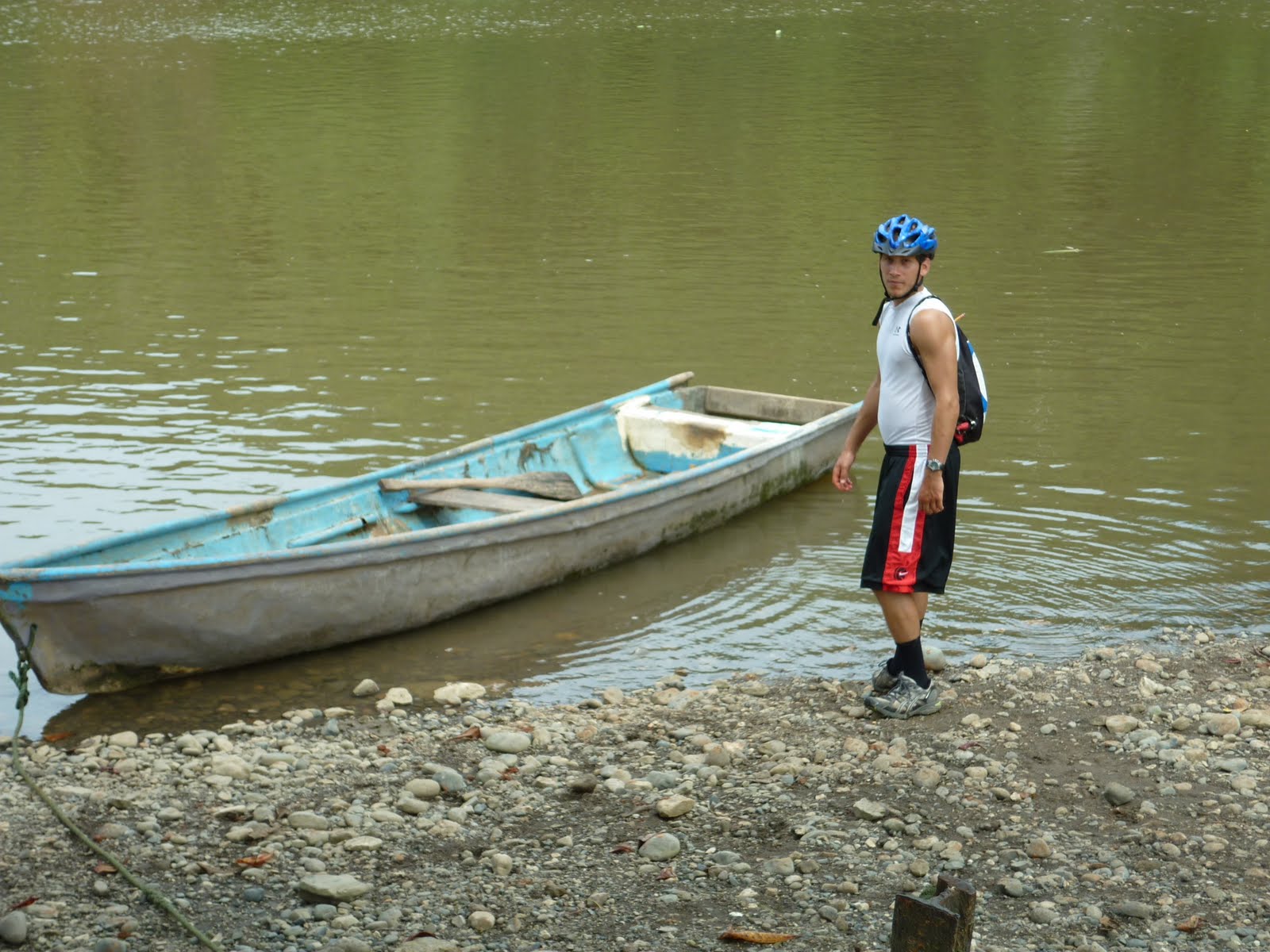
Aunque era un viaje en bicicleta de unos 40 kilómetros, había otras partes, como visitar el sitio arqueológico y pasar por Sierpe, que lo hicieron una verdadera aventura. Dilatamos cuatro horas y media. Regresé bastante cansado pero no tanto como el viaje que hicimos hoy.

En el primer viaje, fuimos tres amigos. Esta vez éramos siete. Parte del camino era de carretera y la otra era de lastre. La de lastre era tortuosa. Subimos algunas cuestas en las cuales no podíamos subir montado. Tuve que desmontarme y llevar la bicicleta. Había una cuesta que se llama “La Matadora”. ¡Que gacho, pero que buen ejercicio! A la vez, subimos muy alto y tuvimos una vista del mar impresionante.
También, oímos los gritos de los congos en el bosque que nos rodeaba.

Después de todas las cuestas, y eventualmente, las bajadas, llegamos otra vez a la carretera. Desde allí, el grupo se separó. Un amigo mío, Javier, y yo continuamos el viaje algunos kilómetros más hasta que llegamos a una playa pequeña que se llama “Ventanas de Osa.” Los otros compañeros se volvieron a Ciudad Cortés. De Ventanas, salimos para la casa y el regreso duró una hora y pico. Veníamos rápidamente. Quien sabe cuantos kilómetros anduvimos hoy, pero les digo que todos fueron de mucha calidad. ¡Casi no puedo levantarme de mi silla! Tal vez aparte del buen ejercicio que hiciera y los lugares lindos que conociera durante esos dos viajes en bicicleta, era más importantes las amistades que hice con los compañeros que fueron conmigo. Espero que pueda hace más viajes así en el futuro.

sábado, 18 de septiembre de 2010
Andando en bici #2
Today, my friend Roy and I went to the beach riding our bikes. In total, the trip took us 2 hours to get there and return to Cortés. I was pleased that we could complete the trip in such a short time. The beach is called Ventanas, which gets its name from the caves that can be explored when the tide is low. It’s a small, authentic Costa Rican beach, with little to no tourists. It’s one of my favorites. When we got there, we took a 30 minute rest, watching the waves crash against the jagged rocks that jet out from both sides of the beach.
When I met up with Roy at the local pulpería to start the trip, I doubted if he was prepared, as he was wearing sandals, a t-shirt, and shorts without a bottle of water. I was decked out in my biking gear and tennis shoes. We joked that while I prepared for the “viaje”, he prepared for the destination of the “viaje”. I have to say, appearances definitely can be deceiving. He was able to ride up the steep parts of the trip with ease!
Ironically, as I was writing this post another biking friend of mine, Javier, called me asking if I was interested in taking a cycling trip tomorrow to a town called “Punta Mala.” Although my legs are pretty tired from today’s trip, I can’t turn down the opportunity for another adventure!
Carlos
When I met up with Roy at the local pulpería to start the trip, I doubted if he was prepared, as he was wearing sandals, a t-shirt, and shorts without a bottle of water. I was decked out in my biking gear and tennis shoes. We joked that while I prepared for the “viaje”, he prepared for the destination of the “viaje”. I have to say, appearances definitely can be deceiving. He was able to ride up the steep parts of the trip with ease!
Ironically, as I was writing this post another biking friend of mine, Javier, called me asking if I was interested in taking a cycling trip tomorrow to a town called “Punta Mala.” Although my legs are pretty tired from today’s trip, I can’t turn down the opportunity for another adventure!
Carlos
miércoles, 15 de septiembre de 2010
Independence Day(s) in Costa Rica
September 15 is Costa Rica’s Independence Day. And, although there is only one official Independence Day, there were at least 2 months of preparation for the event. Since late July the “muchachos and muchachas” from every school in and around my community have been practicing for the town’s “comparsa”, which took place on the eve of Independence Day, and the “desfile”, which took place during the morning of Independence Day. Each school had its own drum line and marchers, all of which were dressed in red, white, and/or blue, demonstrating their patriotism. The drum lines especially prepared for the event. Every afternoon and evening the steady beat of drums could be heard in Cortés, which always gave me the feeling that I was going to battle.
The “comparsa” and “desfile” are essentially parades. However, the “comparsa” which takes place at night, is much more informal and is said to be for the “pachangueros” (party-heads/dancers). Basically, anyone who wants to enter in the parade can do so and act a fool. Some of the participants even dress in a type of Halloween costume and wear spooky masks. There is also a torch which is carried from one town to another. The “desfile” is a more formal event, in which all participants wear classic red, white, and blue outfits, and march proudly throughout the town with the Costa Rican flag.
In comparison with Independence Day in the U.S., which in most parts of the country has become a one day event that gives family and friends the opportunity to get together and have a cookout, in Costa Rica (at least where I live), there are activities a week leading up to the actual day of independence. This is called “la Semana Cívica”. In reality, food has little to do with the celebration. I have to admit, I was somewhat disappointed by this statement. I was told that there aren’t “comidas típicas” for Independence Day because everyone is too tired to cook something special due to all the “bulla” leading up to the event.
However, after observing all the activities and the harsh weather in which the participants marched during the parades, I can see why no one would have the energy to do anything else but rest when the final “desfile” is over. During the “comparsa”, it rained, so most people were soaked by the time they reached the town’s center. And during the “desfile”, which took place in the morning, the “sol” was extra “bravo”, so everyone sweated profusely due to the sun’s incessant heat. In fact, many parents walked by their child’s side and supplied cold water while he/she marched.
Overall, it was definitely a cultural experience. I enjoyed it and learned a lot. It was also nice to see members from all parts of my community come together and celebrate Costa Rica’s independence. Next year (si Dios quiere) I plan to be one of the bearers of the torch that eventually makes its way to my town. That gives me something to look forward to for next year’s Independence Day.
Carlos
The “comparsa” and “desfile” are essentially parades. However, the “comparsa” which takes place at night, is much more informal and is said to be for the “pachangueros” (party-heads/dancers). Basically, anyone who wants to enter in the parade can do so and act a fool. Some of the participants even dress in a type of Halloween costume and wear spooky masks. There is also a torch which is carried from one town to another. The “desfile” is a more formal event, in which all participants wear classic red, white, and blue outfits, and march proudly throughout the town with the Costa Rican flag.
In comparison with Independence Day in the U.S., which in most parts of the country has become a one day event that gives family and friends the opportunity to get together and have a cookout, in Costa Rica (at least where I live), there are activities a week leading up to the actual day of independence. This is called “la Semana Cívica”. In reality, food has little to do with the celebration. I have to admit, I was somewhat disappointed by this statement. I was told that there aren’t “comidas típicas” for Independence Day because everyone is too tired to cook something special due to all the “bulla” leading up to the event.
However, after observing all the activities and the harsh weather in which the participants marched during the parades, I can see why no one would have the energy to do anything else but rest when the final “desfile” is over. During the “comparsa”, it rained, so most people were soaked by the time they reached the town’s center. And during the “desfile”, which took place in the morning, the “sol” was extra “bravo”, so everyone sweated profusely due to the sun’s incessant heat. In fact, many parents walked by their child’s side and supplied cold water while he/she marched.
Overall, it was definitely a cultural experience. I enjoyed it and learned a lot. It was also nice to see members from all parts of my community come together and celebrate Costa Rica’s independence. Next year (si Dios quiere) I plan to be one of the bearers of the torch that eventually makes its way to my town. That gives me something to look forward to for next year’s Independence Day.
Carlos
viernes, 10 de septiembre de 2010
Anécdota #1

En los Estados Unidos cortaba la mora y la frambuesa en las orillas de los caminos. En Costa Rica, cojo la papaya y la pipa.
En los Estados Unidos, pescaba con la caña en un lago, pero en Costa Rica, pesco con bolillos en el mar o un estero.
En los Estados Unidos, cuando los zapatos se rompen, vamos rumbo al “mall” y nos compramos nuevos. En Costa Rica, pues, por lo menos en mi comunidad, cuando se rompen, vamos rumbo a la zapatería para que los arregle. Es igual con la ropa.
En los Estados Unidos, mi juego favorito era “Scrabble” y lo jugaba con mi familia. En Costa Rica, irónicamente, lo juego con mi familia también, pero lo llamamos “Letras”.
En los Estados Unidos, muchísima gente tiene sistemas electrónicos para vigilar su casa. En Costa Rica, el sistema es meter un perro bravo en el corredor.
En los Estados Unidos, durante habla común decimos “dude” y en España, se dice “tío”. Pero en Costa Rica, decimos “Mae” y “bicho”.
En los Estados Unidos, para decir que algo es muy bueno, muchas veces se dice “Nice!”. En Costa Rica decimos “¡Tuanis!”
En los Estados Unidos, todo el mundo tiene un carro. En Ciudad Cortés, toda la comunidad tiene una bicicleta.
En los Estados Unidos, reina el fútbol americano. En Costa Rica, reina el fútbol.
En los Estados Unidos, se chapea el zacate con el cortacésped. En Costa Rica, lo chapeamos con el machete.
En los Estados Unidos, especialmente en las zonas rurales, los campesinos saludan amigablemente con la mano y a veces gritan “Hey!”. En Costa Rica, generalmente saludan igual pero gritan “¡Ey!”.
En los Estados Unidos, casi cada mañana comía un atol de avena para el desayuno. Aquí, en Costa Rica, como el gallo pinto con huevo.
En los Estados Unidos, durante los fines de semana, a menudo familias tienen una barbacoa. En Ciudad Cortés, los vecinos preparan ollas de carne o un ceviche de pianguas.
Estos son algunas de las semejanzas y diferencias entre Estados Unidos y Costa Rica. Puedo continuar con la lista, pero no tengo tanto tiempo. Tal vez, lo haga otro día. Espero que lo disfrutara.
Pura Vida,
Carlos
sábado, 4 de septiembre de 2010
Andando en bici #1
In my community, the bicycle is the number one mode of transportation. At the elementary schools and high school, instead of the “parking lot” being full with cars as it is in the U.S., in Ciudad Cortés, it is full with bicycles. Most bicis are equipped with a “canasta” or “maletero”, which are essential to haul all types of cargo. We carry something as simple as a bag of groceries from “la pulpería” or a sack of “arroz” from the “arrozal”. My bike has the maletero, which is attached to the back of the bici. Also, many people put “guardabarros” around their tires so when they “andan” in the rain, they don’t have a strip of mud across their back. Unfortunately, my bike doesn’t have a place to put “guardabarros”.
It’s quite flat throughout most of the town and save for a couple of paved main roads, most roads are dirt and gravel (lastre). I have not ever timed myself to confirm how much I ride my bike per day to get from place to place, meeting to meeting, or class to class, but I would say at least 30-45 minutes per day. Since we are currently in “invierno”, which is the rainy season for Costa Rica, one has to get accustomed to “andar” in some of the more unfavorable circumstances. Like most people in my community, I try to avoid leaving the house when it rains, as I don’t want to “mojarme”. In fact, when it downpours in Cortés, I like to compare the community to a ghost town because everyone seems to be hiding until the rain stops.
However, there are certain circumstances when there is no “vuelta de hoja”, and I have to get to a certain place at a specific time, and it just happens to be raining cats and dogs (aguacero). It could be my imagination, but this seems to happen to me often, especially when I have an English class or a meeting with the local ECC. For this reason, I have mastered the art of riding my bike with one hand on the handlebar and the other holding the “sombirlla”. I also throw on a poncho or raincoat and even plastic bags to cover my shoes so I don’t have wet feet. I’m not the only person that does this in my community.
The other night, I took my bike riding experiences in the rain to a new level. I only had my “sombrilla” and it was raining “duro”. I did not have plastic bags or a poncho. What was I to do? Determined not to make it home drenched, I decided to ride back home barefoot so I would not soak my shoes. When I got home I felt like I had won a championship because my feet were not drenched. It’s safe to say that a Peace Corps volunteer learns to be quite crafty in some of the most peculiar situations.
There is much more to say about my bici riding experience in my community, so I will be sure to write more in the future. More to come soon from "El Chile de Costa Rica"
Pura vida,
Carlos
It’s quite flat throughout most of the town and save for a couple of paved main roads, most roads are dirt and gravel (lastre). I have not ever timed myself to confirm how much I ride my bike per day to get from place to place, meeting to meeting, or class to class, but I would say at least 30-45 minutes per day. Since we are currently in “invierno”, which is the rainy season for Costa Rica, one has to get accustomed to “andar” in some of the more unfavorable circumstances. Like most people in my community, I try to avoid leaving the house when it rains, as I don’t want to “mojarme”. In fact, when it downpours in Cortés, I like to compare the community to a ghost town because everyone seems to be hiding until the rain stops.
However, there are certain circumstances when there is no “vuelta de hoja”, and I have to get to a certain place at a specific time, and it just happens to be raining cats and dogs (aguacero). It could be my imagination, but this seems to happen to me often, especially when I have an English class or a meeting with the local ECC. For this reason, I have mastered the art of riding my bike with one hand on the handlebar and the other holding the “sombirlla”. I also throw on a poncho or raincoat and even plastic bags to cover my shoes so I don’t have wet feet. I’m not the only person that does this in my community.
The other night, I took my bike riding experiences in the rain to a new level. I only had my “sombrilla” and it was raining “duro”. I did not have plastic bags or a poncho. What was I to do? Determined not to make it home drenched, I decided to ride back home barefoot so I would not soak my shoes. When I got home I felt like I had won a championship because my feet were not drenched. It’s safe to say that a Peace Corps volunteer learns to be quite crafty in some of the most peculiar situations.
There is much more to say about my bici riding experience in my community, so I will be sure to write more in the future. More to come soon from "El Chile de Costa Rica"
Pura vida,
Carlos
domingo, 22 de agosto de 2010
La Romería
2 de Agosto de 2010

La Romería es un peregrinaje católico en Costa Rica, en lo cual miles de costarricenses acuden a la basílica de Nuestra Señora Los Ángeles, en Cartago, para rendir homenaje a la Negrita, la Santa Negra. Los romeros, o peregrinos, empiezan a peregrinar de todas partes del país para eventualmente llegar a Cartago el dos de agosto. Algunos romeros comienzan la travesía hasta una semana antes del dos de agosto, caminando 280 kilómetros, atravesando por terrenos y climas de todos tipos. Participé en este evento cultural con algunos amigos costarricenses.
No peregrinamos 280 kilómetros, sin embargo nuestro camino no era fácil. Partimos de Tarbaca, lo cual se ubica en las afueras de San José en las montañas, a las seis de la mañana. Porque mi sitio como un voluntario está en el sur del país y hace un tanate de calor, me costó acostumbrarme al clima fresco de Tarbaca en el inicio de la caminata. Me vestí en ropa larga para calentarme un poquito. Nos bajamos del cerro de Tarbaca, pasando por los suburbios de Aserrí y Desamparados, para eventualmente llegar a la carretera principal donde andaban en pelota el resto de los romeros, rumbo a Cartago. Como los indígenas, comimos pejibayes cuando teníamos hambre durante el viaje.


Aunque dije que los peregrinos caminan hacia Cartago, realmente la gente se va en todos tipos de formas. Hay romeros jinetes, romeros ciclistas, romeros motociclistas, romeros atléticos, romeros bebes que van en coche, etc. Además, aunque dije que es un evento católico, muchas de las personas que lo hacen, no son católicos. Por sí, algunos no tiene religión. Un peregrino me dijo a lo largo del camino que lo estaba haciendo por la tradición familiar, diversión, y ejercicio de la caminata.


Duramos 6 horas para llegar a la basílica, donde estuvieron todos los peregrinos - algunos descansando en el parque frente a la iglesia y otros haciendo fila para entrar. Hubo dos filas: una para entrar de pie y la otra para entrar de rodillas. Los que entraron de rodillas, se hincaron y se arrastraron en el suelo hasta que llegaron a la figura de la Negrita. La idea era que los peregrinos hicieran un sacrificio para la negrita o la ofrecieran algo. Entré de pie.


Y como uno hubiera predicho, siempre hay negocios que aprovechan de eventos como esto, promocionando sus productos en el nombre de los romeros y la Negrita. Es decir, mucha comercialización. Asimismo, había una gran cantidad de vendedores de comida, ropa, agua bendecida, eincluso lugares para recibir masajes para esos músculos y huesos que le dolían en el camino.


Aparte de ser algo espiritual, sentí, también, que la romería era un evento recreativo y comunitario, en lo que todos costarricenses - bebes hasta adultos - se reunieron a la vez para compartir. Estoy agradecido para poder hacer la romería con amigos y entender los muchos significativos de esta peregrinación en Costa Rica. Quiero hacerlo el próximo año, pero tal vez, empezando de Ciudad Cortés. ¡Eso sería una tregua! No sé si lo aguantaría.

Carlos

La Romería es un peregrinaje católico en Costa Rica, en lo cual miles de costarricenses acuden a la basílica de Nuestra Señora Los Ángeles, en Cartago, para rendir homenaje a la Negrita, la Santa Negra. Los romeros, o peregrinos, empiezan a peregrinar de todas partes del país para eventualmente llegar a Cartago el dos de agosto. Algunos romeros comienzan la travesía hasta una semana antes del dos de agosto, caminando 280 kilómetros, atravesando por terrenos y climas de todos tipos. Participé en este evento cultural con algunos amigos costarricenses.
No peregrinamos 280 kilómetros, sin embargo nuestro camino no era fácil. Partimos de Tarbaca, lo cual se ubica en las afueras de San José en las montañas, a las seis de la mañana. Porque mi sitio como un voluntario está en el sur del país y hace un tanate de calor, me costó acostumbrarme al clima fresco de Tarbaca en el inicio de la caminata. Me vestí en ropa larga para calentarme un poquito. Nos bajamos del cerro de Tarbaca, pasando por los suburbios de Aserrí y Desamparados, para eventualmente llegar a la carretera principal donde andaban en pelota el resto de los romeros, rumbo a Cartago. Como los indígenas, comimos pejibayes cuando teníamos hambre durante el viaje.


Aunque dije que los peregrinos caminan hacia Cartago, realmente la gente se va en todos tipos de formas. Hay romeros jinetes, romeros ciclistas, romeros motociclistas, romeros atléticos, romeros bebes que van en coche, etc. Además, aunque dije que es un evento católico, muchas de las personas que lo hacen, no son católicos. Por sí, algunos no tiene religión. Un peregrino me dijo a lo largo del camino que lo estaba haciendo por la tradición familiar, diversión, y ejercicio de la caminata.


Duramos 6 horas para llegar a la basílica, donde estuvieron todos los peregrinos - algunos descansando en el parque frente a la iglesia y otros haciendo fila para entrar. Hubo dos filas: una para entrar de pie y la otra para entrar de rodillas. Los que entraron de rodillas, se hincaron y se arrastraron en el suelo hasta que llegaron a la figura de la Negrita. La idea era que los peregrinos hicieran un sacrificio para la negrita o la ofrecieran algo. Entré de pie.


Y como uno hubiera predicho, siempre hay negocios que aprovechan de eventos como esto, promocionando sus productos en el nombre de los romeros y la Negrita. Es decir, mucha comercialización. Asimismo, había una gran cantidad de vendedores de comida, ropa, agua bendecida, eincluso lugares para recibir masajes para esos músculos y huesos que le dolían en el camino.


Aparte de ser algo espiritual, sentí, también, que la romería era un evento recreativo y comunitario, en lo que todos costarricenses - bebes hasta adultos - se reunieron a la vez para compartir. Estoy agradecido para poder hacer la romería con amigos y entender los muchos significativos de esta peregrinación en Costa Rica. Quiero hacerlo el próximo año, pero tal vez, empezando de Ciudad Cortés. ¡Eso sería una tregua! No sé si lo aguantaría.

Carlos
Suscribirse a:
Entradas (Atom)