They say that caffeine is a drug. Although by no means am I addicted, I have to say that there is nothing better than sitting down and sharing an afternoon cup of coffee with some great friends in my community. The “cafecito” is one of my favorite and most appreciated aspects of the Costa Rican culture. Even though coffee production is definitely not one of the agricultural activities in my community, as I live in a tropical climate, the afternoon café is still quite ingrained as one of the daily activities.
I love having cafecitos with friends, chatting about a range of subjects - from politics to differences and similarities between US and Tico cultures – and munching on a piece of cheese, bread, or tortilla. It’s even better during Christmas when families and friends are making tamales. ¡Qué rico! Under the influence of café, I have had some of my most memorable conversations with my Tico friends and counterparts. We even come up with new and ambitious project ideas. I usually finish my cafecito feeling like I am on top of the world and that I can help organize any event or work with any mini-empresario. The cafecito is also a time to reflect and can be relaxing.
There is an essence to sharing café and conversing one-on-one with family members or friends. The cafecito could help me sum up what my experience in the Peace Corps is about, which is collaborating and working with people. When my time in the Peace Corps finishes, I’m going to miss the cafecito and look back on it nostalgically, not necessarily for the café or the tortillas, but for the friendships and relationships that having the cafecito helped form.
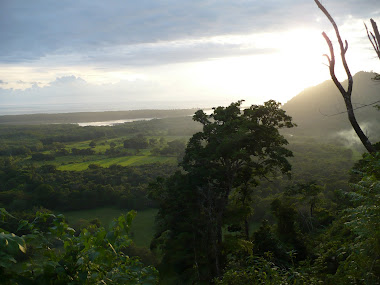
Vista del Gran Río Térraba y la desembocadura al mar
miércoles, 12 de octubre de 2011

jueves, 6 de octubre de 2011
Sounds from the morning 2
It’s 10:30 AM, and as usual in September, at about this hour the morning coolness is wearing off and the afternoon’s sun begins to heat up the tin roofs, making the sound of rain drops as if it were raining. Quite the contrary. It’s just the beginning of an especially dry winter day. We’ll see if this drier weather continues on to October and November, the most heavy hit months for rain.
A man passes the house, shirtless, tugging on his shoulders and head a jumble of pots, pans, and other cast-iron cooking utensils. Who knows where he’s from. I have never seen him before in the community. He’s got to be incredibly strong. He passess by house to house, hoping that a “señora” leaves her morning chores (oficios) to buy something: “SARTENES, OLLAS, COMALES!”, he shouts. These are the perfect tools for this Christmas’ tamales, chicharrones, olla de carnes, and other frituras.
I have no plans to buy anything from him. But I have to admire his determination to even try to sell anything in this heat, much less do so carrying around iron pots and pans. He probably doesn’t even profit much from what he sells, but the little he gains he will take home to his family. It’s humbling. He’s one of the many venders that pass my road from time to time selling anything from newspapers, bread, oranges, to rugs. I hardly ever buy anything from them, but I appreciate listening to their chants from inside the house as they pass by selling.
A man passes the house, shirtless, tugging on his shoulders and head a jumble of pots, pans, and other cast-iron cooking utensils. Who knows where he’s from. I have never seen him before in the community. He’s got to be incredibly strong. He passess by house to house, hoping that a “señora” leaves her morning chores (oficios) to buy something: “SARTENES, OLLAS, COMALES!”, he shouts. These are the perfect tools for this Christmas’ tamales, chicharrones, olla de carnes, and other frituras.
I have no plans to buy anything from him. But I have to admire his determination to even try to sell anything in this heat, much less do so carrying around iron pots and pans. He probably doesn’t even profit much from what he sells, but the little he gains he will take home to his family. It’s humbling. He’s one of the many venders that pass my road from time to time selling anything from newspapers, bread, oranges, to rugs. I hardly ever buy anything from them, but I appreciate listening to their chants from inside the house as they pass by selling.
jueves, 15 de septiembre de 2011
Fruta Milagrosa
As you can imagine there is an incredible variety of tropical fruits in Latin America that many in the U.S. will never have the luxury or luck to try. Quite often, I am introduced to a new, interesting fruit. Not too long ago, I was in the local MAG office, when my friend Carlos, one of the MAG workers wanted to show me a fruit called Fruta Milagrosa (Miracle Fruit, also called Fruta Mágica (Magical Fruit)). Enthusiastically he explained to me that after eating one of these small fruits, which are about the size and shape of a blueberry, all foods that I eat will have a sweetish taste to them. The fruit is also similar in appearance to coffee. The fruit grows on a small bush. I’m not sure if this particular bush will grow much taller but it is currently about 3 feet tall. The fruit tastes similar to a sourer blackberry and has a seed inside.
As Carlos has a propensity to exaggerate, I skeptically believed him and ate the fruit. About 15 minutes later, I went to eat lunch in La Amistad. I had already forgotten that I had eaten the so called “fruta milagrosa” earlier, as I had put little belief into what Carlos had told me, as it sounded like something from a Lord of the Rings movie.
I put a good amount of “chilero” on my food because I like the spicy taste. I don’t have a weak tongue. I took my first bite of rice and beans and I was surprised by the fact that today, lunch had a sweet taste to it. I definitely didn’t notice any of the chile that I had poured on. I could literally eat the seeds of a hot chile pepper and not have any burning sensation. After a few more bites, I then remembered that I had eaten the Fruta Milagrosa, which must be the reason for the pleasant fruity taste to my food. Carlos didn’t exaggerate after all. This fruit, among many others that I have had the pleasure to eat here in Costa Rica, is definitely unique and unlike any other fruit that I have eaten in the U.S.
As Carlos has a propensity to exaggerate, I skeptically believed him and ate the fruit. About 15 minutes later, I went to eat lunch in La Amistad. I had already forgotten that I had eaten the so called “fruta milagrosa” earlier, as I had put little belief into what Carlos had told me, as it sounded like something from a Lord of the Rings movie.
I put a good amount of “chilero” on my food because I like the spicy taste. I don’t have a weak tongue. I took my first bite of rice and beans and I was surprised by the fact that today, lunch had a sweet taste to it. I definitely didn’t notice any of the chile that I had poured on. I could literally eat the seeds of a hot chile pepper and not have any burning sensation. After a few more bites, I then remembered that I had eaten the Fruta Milagrosa, which must be the reason for the pleasant fruity taste to my food. Carlos didn’t exaggerate after all. This fruit, among many others that I have had the pleasure to eat here in Costa Rica, is definitely unique and unlike any other fruit that I have eaten in the U.S.
domingo, 11 de septiembre de 2011
Eating Habits
It may be of interest to my family and friends to know what my eating habits are like in Costa Rica. Although I live on my own, I still keep much of what I eat pretty Tico. After all, there is nothing better than a plate of gallo pinto for breakfast or a typical casado for lunch. In the US, I almost always ate a bowl of oatmeal for breakfast. In Costa Rica, I still eat my bowl of oatmeal. However, on the side I like to have a bowl of chopped papaya, pineapple, and coco, and a side plate of plátano maduro. I know it’s a lot of fruit and may even be too much, but I certainly am not gaining weight and when there is so much abundance, I figure why not take advantage of the extra vitamins.
For lunch, I eat at the local “soda” La Amistad. Doña Norma, the restaurant’s cook and owner treats me like a son and always serves me a riquísimo typical Costa Rican casado or soup. On Mondays she prepares my favorite, olla de carne, which is similar to a beef stew in the US. Olla de carne is loaded with ayote (a type of squash), chayote, plátano, yuca, camote (sweet potato), papa (potato), cilantro, cebolla (onion), etc. Thursday is another soup day, though it varies which type of soup. She sometimes prepares a sopa de pescado o pollo, but usually she makes a sopa de mondongo, which uses the cow�e99s stomach. The other days of the week, I eat the classic “casado”, which consists of a plate of rice, beans, a picadillo and/or salad with pollo en salsa, carne en salsa, bistek, or chuleta. I especially enjoy eating at La Amistad because I always have great conversations with the restaurant’s owner and its clients, as many work in the OIJ (the Costa Rican government’s FBI), the local courthouse, the hospital, or are older community members that have unbelievable stories about what Ciudad Cortés was like in the United Fruit Company years.
Around 4:00 PM, I like to have a cafecito with my friends from the Panadería Murillo. We like to drink our coffee strong, which we jokingly call “café con el “American Touch.” El cafecito gives me that extra boost to participate in my evening activities. Its always accompanied by a good conversation con mis amigos.
For dinner, I typically prepare my famous “sancocho” with an egg or a slice of cheese. The “sancocho”, which I have proudly nicknamed it, consists of a huge bowl of vegetables that I have either grown in my garden such as okra, yucca, green beans, and mustard, or that I have bought from one of the local farmers such as ayotes or elotes (corn). I also throw in all the spices that I have in my garden such as chile peppers, basil, oregano, ginger, tumeric, cilantro, and lemon grass. I have to say, it’s quite simple (or complex) – a huge bowl of boiled vegetables with a piece of cheese (which is also bought locally) – but I have never gotten tired of it. I’m so accustomed to always having fresh produce that when I go back to the US, not having access to the abundance of fruits and vegetables will be something that is difficult to get accustomed to.
For lunch, I eat at the local “soda” La Amistad. Doña Norma, the restaurant’s cook and owner treats me like a son and always serves me a riquísimo typical Costa Rican casado or soup. On Mondays she prepares my favorite, olla de carne, which is similar to a beef stew in the US. Olla de carne is loaded with ayote (a type of squash), chayote, plátano, yuca, camote (sweet potato), papa (potato), cilantro, cebolla (onion), etc. Thursday is another soup day, though it varies which type of soup. She sometimes prepares a sopa de pescado o pollo, but usually she makes a sopa de mondongo, which uses the cow�e99s stomach. The other days of the week, I eat the classic “casado”, which consists of a plate of rice, beans, a picadillo and/or salad with pollo en salsa, carne en salsa, bistek, or chuleta. I especially enjoy eating at La Amistad because I always have great conversations with the restaurant’s owner and its clients, as many work in the OIJ (the Costa Rican government’s FBI), the local courthouse, the hospital, or are older community members that have unbelievable stories about what Ciudad Cortés was like in the United Fruit Company years.
Around 4:00 PM, I like to have a cafecito with my friends from the Panadería Murillo. We like to drink our coffee strong, which we jokingly call “café con el “American Touch.” El cafecito gives me that extra boost to participate in my evening activities. Its always accompanied by a good conversation con mis amigos.
For dinner, I typically prepare my famous “sancocho” with an egg or a slice of cheese. The “sancocho”, which I have proudly nicknamed it, consists of a huge bowl of vegetables that I have either grown in my garden such as okra, yucca, green beans, and mustard, or that I have bought from one of the local farmers such as ayotes or elotes (corn). I also throw in all the spices that I have in my garden such as chile peppers, basil, oregano, ginger, tumeric, cilantro, and lemon grass. I have to say, it’s quite simple (or complex) – a huge bowl of boiled vegetables with a piece of cheese (which is also bought locally) – but I have never gotten tired of it. I’m so accustomed to always having fresh produce that when I go back to the US, not having access to the abundance of fruits and vegetables will be something that is difficult to get accustomed to.
sábado, 27 de agosto de 2011
Sounds from the morning
The sun rises and sets early here in Costa Rica. That means if one wants to take advantage of daylight, and the coolness of the morning before it gets hot and humid, one needs to wake up quite early, at least for US standards. Activity - and not always human activity - usually starts around 5:30 AM. Like it or not, I am almost always waken up around this time by either the seemingly thousands of roosters that surround my house or the chirping of the “cocalecas.” The scientific name for this bird species is Aramides cajanea. Cocaleca is the word Costa Rican’s use, perhaps because they make a sound that is somewhat similar to the name.
By about 6:00 AM, the sounds of bicycles passing my house begin to be heard. There are several bread-sellers that ride through the neighborhoods with large carts filled with baguettes attached to the front of a bicycle and a horn attached to the handlebar to signal the arrival of the day’s freshly baked bread. “LLEGOOOO LLEGOOOO…… (HORN SOUNDS).” By this point it’s about 6:30 AM and the borrowed U.S. yellow school bus, which is used to transport locals from Cortés to Ojo de Agua instead of students, rumbles by, shaking the foundation of my house.
By 7:00 AM, the streets have quite a bit of activity as high school and elementary students are on their way to school, gently poking along on their bikes while talking in groups of friends. Also, many adults are reporting to work at this time. This routine is quite different to that in the US, where many people on a work day aren’t getting to work until 8:00 or 8:30 AM.
With all these sounds and movements, it definitely puts pressure on me to start my days bright and early with lots of activity. This can lead to exhaustion by the end of the day, as many of my activities don’t actually start until the evening. This means I start my day at 6:00 AM, but it often doesn’t finish until 9:00 PM. It’s safe to say, by the end of the days I am sometimes dizzy due to fatigue. I am still working on finding an equilibrium between resting sufficiently and taking advantage of the sunlight before it gets dark at 5:30 PM.
By about 6:00 AM, the sounds of bicycles passing my house begin to be heard. There are several bread-sellers that ride through the neighborhoods with large carts filled with baguettes attached to the front of a bicycle and a horn attached to the handlebar to signal the arrival of the day’s freshly baked bread. “LLEGOOOO LLEGOOOO…… (HORN SOUNDS).” By this point it’s about 6:30 AM and the borrowed U.S. yellow school bus, which is used to transport locals from Cortés to Ojo de Agua instead of students, rumbles by, shaking the foundation of my house.
By 7:00 AM, the streets have quite a bit of activity as high school and elementary students are on their way to school, gently poking along on their bikes while talking in groups of friends. Also, many adults are reporting to work at this time. This routine is quite different to that in the US, where many people on a work day aren’t getting to work until 8:00 or 8:30 AM.
With all these sounds and movements, it definitely puts pressure on me to start my days bright and early with lots of activity. This can lead to exhaustion by the end of the day, as many of my activities don’t actually start until the evening. This means I start my day at 6:00 AM, but it often doesn’t finish until 9:00 PM. It’s safe to say, by the end of the days I am sometimes dizzy due to fatigue. I am still working on finding an equilibrium between resting sufficiently and taking advantage of the sunlight before it gets dark at 5:30 PM.
sábado, 20 de agosto de 2011
“Un día de estos”
This is a common saying among Ticos. It’s equivalent to saying “one of these days….” in English. It has the same promise (or sometimes vagueness of when or if it will happen) of an event passing in the future. It’s used in the context of when someone is promising to plan a trip, project, or cafecito with someone. For example, it’s to say, “One of these days, we’re going to go on that fishing trip that we have been talking about for the past year.” I hear it so often, that I usually think to myself “And if one of these days never comes?” Because the truth is, that time, ever since I joined the Peace Corps has never been the same. Why is time passing by so quickly? Is it the same for those that live in other parts of the world? Back home? Or does time only fly in Costa Rica? Are the days, weeks, months, and years getting shorter? I was talking with a friend in my community about this, and he told me that somewhere in the Bible it states that when the end of the world is near, time will become shorter. It almost seems true. I often reflect, stunned, by the fact that I’m already 25 years old, or that there are only about 4 months left in this year’s calendar. Time’s shortness for me can almost be unfair. Everyday, I try to make the most out of the little time I have, because time for me is flying.
miércoles, 17 de agosto de 2011
Ode to Gallo Pinto
Gallo pinto is a classic Costa Rican dish, usually eaten for breakfast, which consists of rice and beans mixed together with chopped onion, red pepper, and cilantro. Of course, one cannot forget to throw in a little Salsa Lizano, a Costa Rican brand sauce, which if not added, would probably not be gallo pinto. Although it varies from person to person, garlic is also sometimes added. I have to admit, I am a fanatic of the pinto, especially for breakfast. For me, there is nothing better than a plate of gallo pinto, a slice of cheese or an egg, tortilla, and a large cup of warm café in the morning. If the pinto is well-made, I could honestly eat it for lunch and dinner as well.
Ironically, even when I am living by myself, I still like to fix myself gallo pinto. However, my pinto is made with an “estilo gringo.” I use the above ingredients, however I also like to use lots of fresh spices from my garden, such as fresh ginger, turmeric, lemon grass, basil, cilantro, and oregano. I know, lots of spices, but since I am growing them, why not use them? It only adds to the taste. Also, for the pinto to have a little kick, I also throw in a small chile pepper and a piece of garlic. That’s my version of the traditional gallo pinto. It’s one of the many customs that I will definitely take back with me to the U.S. after I finish the Peace Corps.
Ironically, even when I am living by myself, I still like to fix myself gallo pinto. However, my pinto is made with an “estilo gringo.” I use the above ingredients, however I also like to use lots of fresh spices from my garden, such as fresh ginger, turmeric, lemon grass, basil, cilantro, and oregano. I know, lots of spices, but since I am growing them, why not use them? It only adds to the taste. Also, for the pinto to have a little kick, I also throw in a small chile pepper and a piece of garlic. That’s my version of the traditional gallo pinto. It’s one of the many customs that I will definitely take back with me to the U.S. after I finish the Peace Corps.
Suscribirse a:
Entradas (Atom)